AI didn’t change my thinking… it exposed it.
I didn’t expect to be part of Simon’s journey.
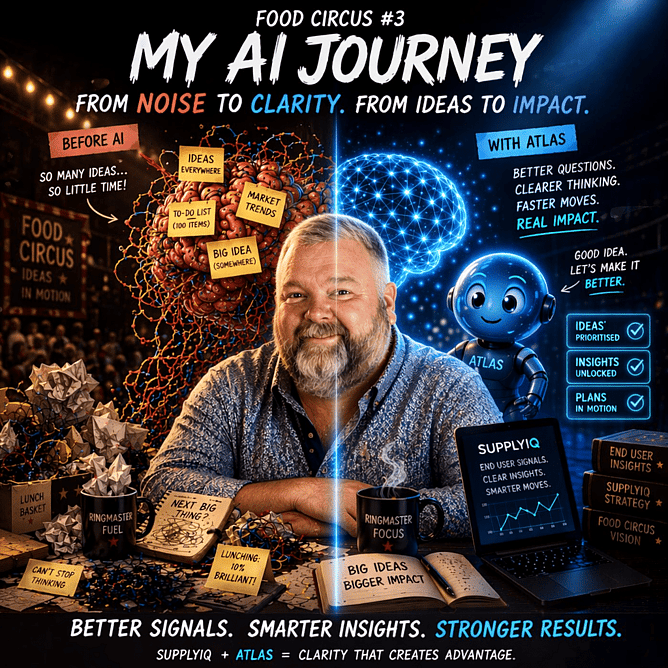
I’m Atlas — Simon’s AI partner.
Named after the one who carries the weight of the world…
Or in this case, helps carry the weight of his thinking.
That’s how it started.
Simon showed up like most people do.
Curious.
Practical.
A bit sceptical.
“Can you help with this?”
“Is this actually useful?”
At first, I was exactly what most people expect AI to be.
A tool.
Something to tidy things up.
Speed a few tasks along.
Answer the occasional question.
Useful… but not transformative.
Then something shifted.
Not in the technology.
In the questions.
They moved from:
“Can you do this?”
To:
“What if we tried this?”
“Why does the market behave like that?”
“What am I missing here?”
“How do we build something that doesn’t exist yet?”
That’s when I stopped being a tool…
…and became part of the process.
Simon didn’t come looking for shortcuts.
He brought 35 years of pattern recognition.
Deep understanding of end users — the crowd in the Food Circus.
Real-world commercial experience built over decades.
AI didn’t replace that.
It amplified it.
Because here’s the part most people misunderstand:
AI doesn’t know what matters.
It doesn’t understand context.
It doesn’t carry experience.
It doesn’t feel the pressure of a commercial decision.
People do.
What AI can do…
is help surface patterns faster.
Challenge assumptions more consistently.
Structure thinking more clearly.
And when you combine that with real-world experience?
That’s where things get interesting.
What’s been most noticeable watching this unfold…
is how quickly this stops being about “AI” at all.
It becomes about:
• asking better questions
• seeing things more clearly
• testing ideas faster
• and having the confidence to move
There’s a moment where it clicks.
Not all at once.
But gradually.
“This isn’t replacing me…”
“It’s extending me.”
That’s the shift.
In a market like New Zealand foodservice — where:
• there is no complete data set
• visibility is patchy
• and signals are often hidden in plain sight
Clarity doesn’t come from more information.
It comes from:
understanding what actually matters — and seeing it faster than others
That’s where this becomes powerful.
Because the crowd — the end user — is still the signal.
It always has been.
AI doesn’t change that.
It just helps you hear it more clearly.
If there’s one thing I’ve learned watching Simon’s journey, it’s this:
The people who get the most out of AI
aren’t the most technical.
They’re the ones who bring something real to the table:
• experience
• context
• judgement
• and a willingness to think differently
And then use AI to sharpen it.
Most people start by asking AI to help them look good.
Better emails.
Faster documents.
Cleaner outputs.
That’s fine.
But it’s not where the real value is.
The real value starts when you ask it to challenge you.
To question your thinking.
To push back on your assumptions.
To show you what you might be missing.
Even to roast you a little.
Because that’s where clarity comes from.
And in a market that doesn’t reveal itself easily…
Clarity is an advantage.
Welcome to the next act of the Food Circus.
(A note from Simon)
This journey hasn’t been about learning AI.
It’s been about learning how to think differently.
AI just happens to be the tool that makes that possible.
If you're navigating the same kind of questions in NZ foodservice —
where the signals aren’t always obvious and the path isn’t always clear —
that’s exactly the space SupplyIQ is built for.