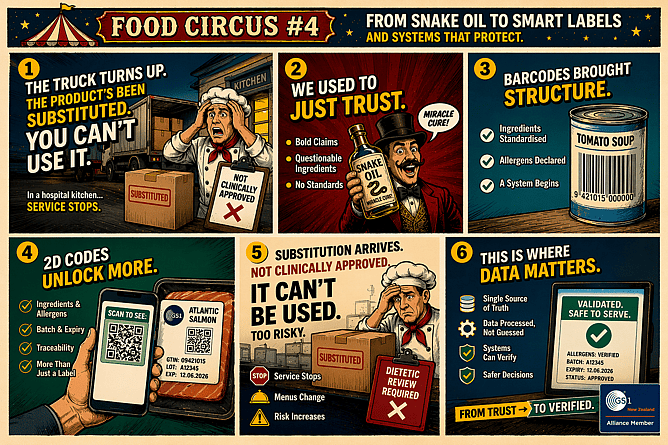
There was a time when product labels were closer to snake oil than science.
Claims were bold.
Ingredients were questionable.
And trust was assumed, not earned.
The evolution of trust
Over time, structure replaced ambiguity.
Ingredients became standardised.
Allergens were declared.
Nutritional panels improved transparency.
Barcodes created consistency.
Organisations like GS1 New Zealand have played a critical role — not just for manufacturers, but for consumers, retailers, and supply chain participants — by standardising how products are identified and understood globally.
But one limitation always remained:
A physical label can only hold so much information.
The shift to smart labels
2D barcodes (including GS1 QR codes) remove that limitation.
They extend the label beyond the pack — into a structured, digital data layer.
A single scan can connect to:
detailed ingredient and allergen information
sourcing and origin data
preparation and usage guidance
brand and product storytelling
But more importantly…
They can carry structured, machine-readable data, including:
batch and lot numbers
expiry and best-before dates
traceability information
This enables not just visibility…
But automation.
For example:
data can be processed at point of sale
expired or recalled products can be flagged or blocked
systems can act on data, not just display it
In simple terms:
The label evolves from static information… to an active part of the system.
The behaviour shift
For years, adoption was uncertain.
“Will people actually scan them?”
In New Zealand, COVID changed that overnight.
Scanning became:
normal
instinctive
expected
At the same time, trust evolved.
Consumers and end users no longer accept static claims —
they expect the ability to verify.
The catch: trust still depends on execution
A 2D barcode can take you anywhere.
Which makes execution critical.
When someone scans, they expect:
a clear connection to the product in hand
relevant, value-adding content
a seamless, intuitive experience
Not:
a generic homepage
disconnected promotions
or information that feels out of place
If the experience doesn’t deliver value…
Trust breaks.
And once trust breaks, behaviour stops.
Why this matters in Foodservice
Foodservice has a unique challenge:
It has never had a true structured data layer.
Unlike retail, where products are physically handled, foodservice operates largely in a digital environment.
Operators are often heavily reliant on digital product information.
They depend on:
supplier reps
websites
PDFs
internal knowledge
Much of it:
fragmented
inconsistent
manually interpreted
At the same time, expectations are high — especially in sectors like:
aged care
healthcare
education
Where accuracy, allergens, and food safety are critical every day.
The opportunity
2D barcodes — implemented through structured systems like GS1 — can fundamentally change this.
They enable:
a single source of trusted product data
improved allergen and food safety confidence
reduced reliance on fragmented communication
integration into digital ordering and operational systems
a shift from human-readable information → machine-processed data
They also open the door to:
automated validation
recall management
real-time product assurance
This is not just more information.
It’s better information.
Structured. Connected. Actionable.
The bigger shift
This is about raising expectations across the ecosystem:
Relevance – information that matches the product and the moment
Simplicity – easy access, no friction
Trust – consistent, verifiable, reliable
Control – systems that can act on data when it matters
The takeaway
We’ve moved from a world where labels asked us to trust…
To one where systems allow us to verify — and even enforce.
But that only works if the experience behind the scan delivers real value.
Because in the Food Circus…
Even a small square on a pack
can become the foundation of a smarter, safer, more connected system.