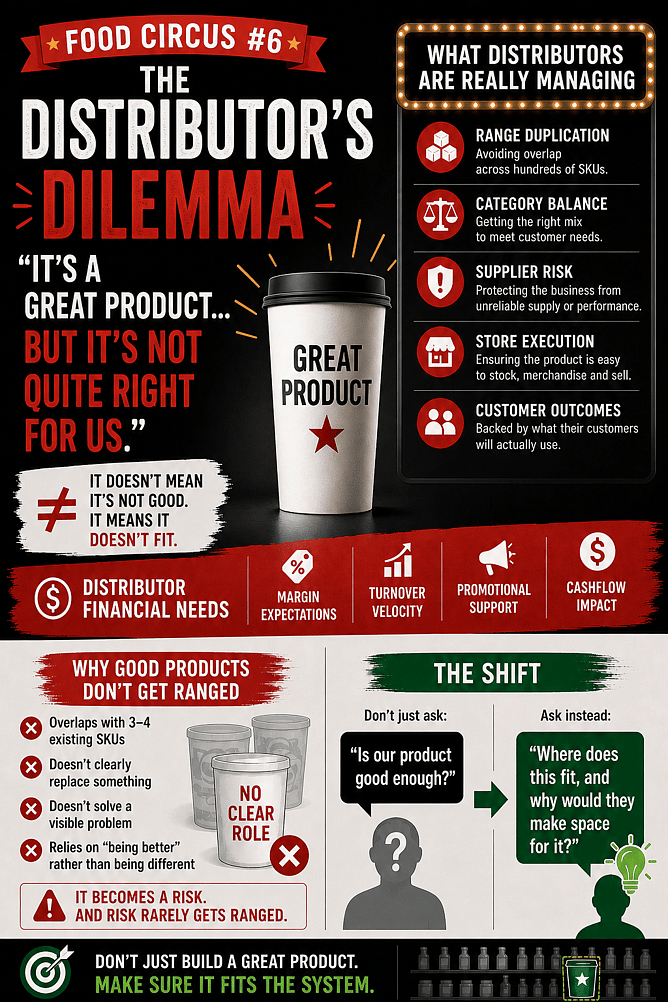
“It’s a great product… but it’s not quite right for us.”
If you’ve been in foodservice long enough, you’ve heard this line.
For many suppliers, it’s one of the most frustrating responses they can get.
Because on the surface, it doesn’t make sense.
If the product is good… why wouldn’t it be ranged?
The Real Reason Your Product Isn’t Getting Ranged
Most suppliers assume this feedback means one thing:
“Our product isn’t good enough.”
In reality, that’s rarely the issue.
More often than not, the product is fine — sometimes even excellent.
The real issue is much simpler:
It doesn’t fit.
What Foodservice Distributors Are Actually Managing
Foodservice distributors don’t just choose products — they manage a system.
Every ranging decision needs to balance multiple factors:
Range Duplication
How many similar products already exist in the category?
If your product overlaps with multiple existing SKUs, it becomes harder to justify.
Category Balance
Categories are structured deliberately.
Good / Better / Best.
Value vs Premium.
Different formats and use cases.
Your product needs a clear role within that structure.
Supplier Risk
Can you supply consistently?
Can you scale?
Will you actively support the product?
Even great products become difficult to range if the supplier introduces risk.
Store Execution
Will stores understand how to sell it?
Is it easy to merchandise?
Does it create simplicity or complexity at store level?
If it’s hard to execute, it becomes a barrier.
Customer Outcomes
Ultimately, everything comes back to this:
Will operators actually use it — and reorder it?
Because if it doesn’t move, it doesn’t stay.
Distributor Financial Requirements
This is one of the most overlooked factors.
Distributors are running a business — not just listing products.
That means your product needs to work commercially across:
Margin expectations
Cashflow impact
Turnover velocity
Return on space
Promotional support requirements
If the numbers don’t stack up, the product doesn’t stack up.
Why Good Products Still Don’t Get Ranged
When you step back, a clear pattern emerges.
Products tend to struggle when they:
Overlap with 3–4 existing SKUs
Don’t clearly replace something already in the range
Don’t solve a visible, practical problem
Rely on being “better” rather than meaningfully different
At that point, the product becomes a risk.
And in foodservice:
Risk rarely gets ranged.
Where Suppliers Get Stuck
This is where many small to mid-sized suppliers run into problems.
They walk into ranging conversations with:
A good product
Strong belief in what they’ve created
Positive feedback from early users
But they haven’t answered the most important question:
“Where does this fit?”
Without a clear answer, the distributor has to figure it out themselves.
And if they can’t quickly see the role…
They move on.
The Shift That Changes Everything
Most suppliers start by asking:
“Is our product good enough?”
The suppliers who succeed ask something different:
“Where does this fit, and why would they make space for it?”
This shift changes everything.
Because now you’re not just presenting a product — you’re presenting:
A role in the category
A reason to replace something
A reduction in risk
A clear path to sales and reorder
What a Strong Product Fit Looks Like
When a product fits, it becomes obvious.
It will typically:
Solve a specific operational problem
Improve speed, consistency, or efficiency
Replace an underperforming product
Fill a genuine gap in the range
Work commercially for everyone in the chain
At that point, the conversation changes.
From:
“Why should we take this?”
To:
“How quickly can we get this ranged?”
How SupplyIQ Helps Foodservice Suppliers Get Ranged
At SupplyIQ, this is where we focus.
Not just on improving your product story…
But on making sure your product actually fits the system it’s trying to enter.
That includes:
Understanding category structure and range dynamics
Identifying real opportunities (not assumed ones)
Defining a clear product role
Aligning pricing and commercial expectations
Reducing risk for distributors
Because in foodservice:
It’s not enough to be good.
You have to belong.
Final Thought
Foodservice isn’t a free-for-all.
It’s a curated system.
And space is limited.
The products that succeed aren’t always the best ones.
They’re the ones that fit.
Need Help Understanding Where Your Product Fits?
If you’re trying to work out where your product actually fits,
I’m always up for a straight conversation.